
柔性电子产品的快速发展推动了智能电子纺织品向显示、感知和交互一体化方向发展。其中,交流电致发光(ACEL)器件能够将传感信息实时转化为可视化光信号,是构建智能可穿戴系统和新一代人机交互平台的重要功能单元。
近日,浙江理工大学纺织科学与工程学院(国际丝绸学院)胡毅教授团队在国际知名期刊Advanced Functional Materials上(影响因子19.9)在线发表了题为《Multifunctional Solid-State Carbon Dots Enabling Multicolor Stretchable AC Electroluminescent Devices for Intelligent Human Motion Monitoring》的研究论文。本研究提出了一种结构简化、多色、本征可拉伸的交流电致发光器件,其核心创新在于采用了兼具优异荧光性能与高介电常数的多功能固态碳点作为色彩转换与介电调控一体的多功能填料。论文DOI:10.1002/adfm.77166。浙江理工大学纺织科学与工程学院(国际丝绸学院)硕士研究生邢佳丽为本文第一作者,通讯作者为浙江理工大学博士生导师胡毅教授。
随着柔性电子、智能穿戴和人机交互技术的快速发展,兼具可拉伸、多色显示和实时信息反馈能力的柔性光电器件成为推动下一代智能系统发展的关键。然而,传统ACEL器件仍面临发光颜色单一、依赖复杂多层结构实现颜色调控以及发光材料稳定性不足等问题,如何利用高稳定、多功能发光材料构建结构简化的多色可拉伸ACEL器件,并实现显示与智能感知功能的集成,成为柔性光电领域亟待解决的重要挑战。鉴于此,浙江理工大学纺织科学与工程学院(国际丝绸学院)博士生导师胡毅教授课题组报道了一种基于多功能固态碳点(CDs)的多色可拉伸交流电致发光器件,实现了发光、颜色调控与人体运动监测功能的一体化集成。该研究通过对苯二甲醛和对苯二乙腈进行溶剂热反应,制备了具有黄光至橙红光可调发射特性的固态碳点,并利用其优异的聚集诱导发光(AIE)特性和可调介电响应能力,在避免传统荧光材料固态聚集猝灭的同时,为光转换调控和电场调节提供了功能化材料基础。研究团队创新性地将碳点与ZnS:Cu发光颗粒共同引入静电纺丝制备的TPU纳米纤维发光层中,构建了单层集成式多色ACEL结构,显著简化了传统器件多层颜色转换的复杂结构。进一步通过集成电阻式应变传感器和蓝牙模块,构建了具备运动感知、视觉反馈和无线传输功能的智能可穿戴系统,实现人体运动状态的实时可视化监测。该研究为固态碳点在柔性光电器件中的应用提供了新策略,并为智能纺织品、柔性显示及人机交互系统的发展提供了重要技术支撑。
图1 器件的结构、光学特性与应用

Figure 1. Structure, optical properties and applications of the ACEL device. (a) Structure overview of the multicolor stretchable ACEL device. (b) Dual mechanism of color?conversion and dielectric regulation by CDs in ACEL devices. (c) Variation in bottom?electrode resistance with knee joint flexion. The inset illustrates device operational states at corresponding knee?bending angles. (d) EL driver control panel that senses changes in resistance. (e) Simulation of application scenarios for multicolor stretchable ACEL devices used in human motion monitoring.
通过将电致发光、颜色转换与应变传感功能集成于同一柔性平台,构建了基于TPU纳米纤维发光层、EGaIn柔性电极和碳点调控体系的多功能ACEL器件。利用液态金属电极的高导电性与可拉伸特性,实现器件在机械变形下稳定发光;结合电阻式传感模块和蓝牙通信系统,实现人体关节运动信号采集、无线传输以及多色光学反馈,为智能可穿戴显示与人机交互提供了新的器件架构。
图2 ACEL器件的制备与优化
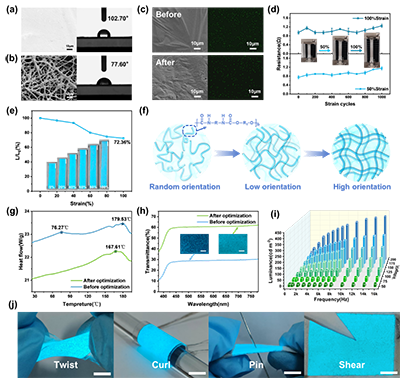
Figure 2. Preparation and optimization of ACEL devices. Surface SEM and corresponding contact angle images of conventional (a) vs electrospun nanofibrous (b) luminescent layers. (c) SEM and corresponding EDS images of EGaIn on the nanofibrous luminescent layer before and after water?bath sonication. (d) Strain test of the EGaIn bottom electrode. Inset: Photographs of the electrode at 0%, 50%, and 100% strain levels. Strain is defined as (L-L0)/L0, where L0 is the original length and L is the stretched length. Scale bar: 1 cm. (e) Luminance retention of the ACEL device under varying tensile strains. Inset: Photographs of the device being elongated from 0% to 100% strain. Scale bar: 1 cm. (f) Schematic illustration of varying molecular segment alignment in TPU. (g) DSC curves of TPU nanofiber membranes before and after electrospinning parameter optimization. (h) Transmittance of nanofibrous luminescent layers before and after parameter optimization. Inset: Luminance of corresponding devices. Scale bar: 1 cm. (i) Luminance variation of ACEL devices by frequency and voltage settings. (j) Mechanical stress testing: twisting, curling, pining and shearing.
通过构筑具有高表面能和多孔结构的TPU纳米纤维发光层,增强了其与EGaIn电极之间的界面结合,提高了器件在拉伸过程中的电学稳定性。同时,通过优化静电纺丝参数调控TPU分子链排列,抑制链段取向诱导的微晶结构形成,提高发光层透明性和光输出效率,实现了兼具高亮度与优异机械耐久性的柔性ACEL器件。
图3 碳点的结构测试与表征
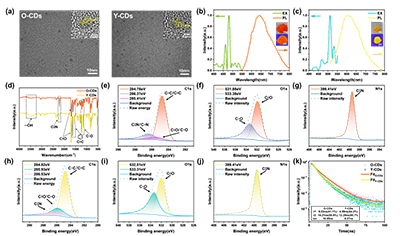
Figure 3. Structural testing and characterization of CDs. (a) TEM images of O-CDs and Y-CDs. Normalized excitation maxima and PL spectra of O?CDs (b) and Y?CDs (c), with photographs under visible and UV 365?nm light. (d) FTIR spectra of both CDs. High-resolution C 1s (e), O 1s (f), and N 1s (g) spectra of O-CDs. High-resolution C 1s (h), O 1s (i), and N 1s (j) spectra of Y-CDs. (k) Fluorescence lifetimes of both CDs.
通过调节前驱体比例和反应条件,制备了具有黄光至橙红光可调发射特性的固态碳点。TEM、FTIR、XPS及荧光寿命分析表明,不同表面官能团组成、碳核尺寸及共轭结构共同决定碳点的电子结构和发光行为。其中,氧含量、氰基结构以及π共轭程度的差异导致黄色碳点和橙色碳点产生不同的发射特性,为实现ACEL器件多色调控提供了稳定的发光材料基础。
图4 碳点的介电性质及其对ACEL器件的影响
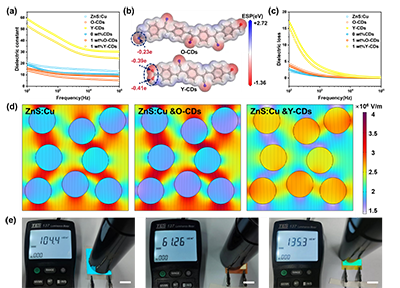
Figure 4. The dielectric properties of CDs and their impact on ACEL devices. Scale bar: 1 cm (a) Dielectric constants of different particles and the luminescent layer. (b) Electrostatic potential simulation of the representative molecular structure of CDs. (c) Dielectric loss of different particles and the luminescent layer. (d) Simulation of the internal electric field distribution in the device with TPU&CDs treated as a homogeneous medium. (e) Luminance comparison of the three color devices.
不同结构的碳点表现出显著差异化的介电响应,其中高介电常数黄色碳点能够优化复合发光层中的电场分布,增强ZnS:Cu发光颗粒周围局部电场,提高电子激发效率;而低介电常数橙色碳点则改变电场分配,并结合自身光转换能力调节最终发光颜色。该研究建立了碳点结构—介电性能—电场调控—发光行为之间的关联,为设计高性能ACEL器件提供了新的调控策略。
图5 碳点对ACEL器件色彩转换的机理
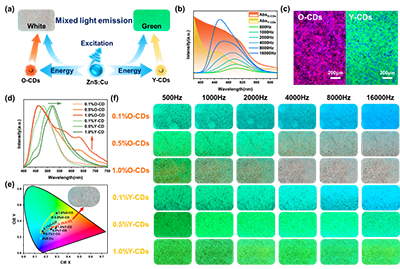
Figure 5. Multicolor ACEL Devices. (a) Mechanism of device color conversion. (b) Overlap of CDs UV absorption spectra with ZnS:Cu EL spectra at varying driving frequencies. (c) Fluorescence microscopy image of the CDs-embedded luminescent layer surface. EL spectra (d) and corresponding CIE chromaticity coordinates (e) of ACEL devices with varying CDs concentrations. (f) The color of the ACEL device is synergistically regulated by the CDs concentrations and the driving frequency.
固态碳点通过吸收ZnS:Cu产生的激发光,并进行长波光转换,与原始电致发光共同作用实现颜色调节。通过调节碳点种类、浓度以及交流驱动频率,实现蓝光、白光、橙光及黄绿色光之间的连续可调输出。同时,碳点优异的聚集诱导发光特性保证了其在高浓度固态环境中的稳定发光,为构建结构简单、色彩丰富的柔性显示器件提供了有效途径。
图6 碳点及ACEL器件的稳定性
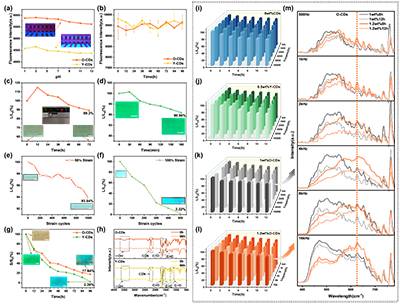
Figure 6. Stability of CDs and ACEL devices . Scale bar: 1 cm. (a) pH stability test of CDs. Double 85 °C/85% RH wet-hot testing of CD composite nanofibers (b) and the ACEL device (c). Inset: devices before and after testing. (d) Washing test. Inset: Devices before and after 180 min of washing. Luminance stability of devices after 50% (e) and 100% (f) cyclic strain. Inset: Devices before and after strain. (g) UV resistance test of ACEL devices containing O-CDs and Y-CDs. Inset: Devices before and after 96 h of UV exposure. (h) FTIR spectra of O-CDs and Y-CDs before and after 96 h of UV irradiation. Luminance stability of blue (i), green (j), white (k), and orange (l) ACEL devices after continuous operation for 12 h at different driving frequencies. (m) EL spectra of white and orange ACEL devices before and after continuous operation for 12 h at different driving frequencies.
固态碳点在宽pH范围、高温高湿以及紫外辐照环境中保持良好的结构稳定性,并赋予ACEL器件优异的环境适应能力。同时,器件在反复拉伸、弯曲、折叠及水洗过程中仍保持稳定发光性能,证明其能够满足实际可穿戴应用中的机械可靠性需求,为柔性显示器件长期服役提供了重要保障。
图7 集成视觉应变传感的多色可拉伸ACEL器件
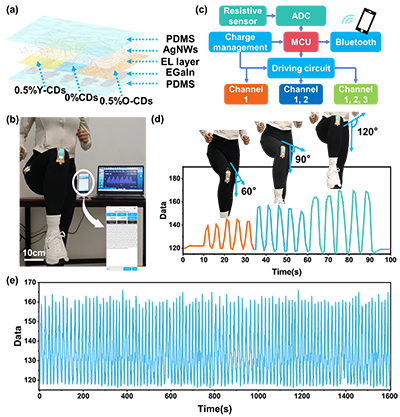
Figure 7. Multi-color stretchable ACEL integrated with resistive sensing. (a) Schematic of the multicolor stretchable ACEL device with integrated resistive sensing. (b) Schematic of a smart electronic garment integrating resistive sensing, visual display, and Bluetooth transmission for motion monitoring. Scale bar: 10 cm. (c) Block diagram of the ACEL device circuit with integrated resistance monitoring and Bluetooth transmission. (d) Wireless resistance data transmission via Bluetooth. Inset: Knee joint bending. (e) Resistance variation of the ACEL device during 100 cycles of knee joint bending via Bluetooth.
通过将多色发光区域与应变感知电极结合,建立了机械形变、电信号变化和光学输出之间的直接映射关系。系统能够实时检测人体关节运动,并根据运动幅度控制不同颜色光信号输出,同时借助蓝牙模块实现数据无线传输。该集成化设计突破了传统柔性传感器依赖外部显示设备的限制,为智能服装、运动监测和下一代人机交互系统提供了新的发展方向。
小结:作者开发了一种基于固态碳点调控的多色可拉伸交流电致发光器件,通过将具有聚集诱导发光特性的碳点与ZnS:Cu发光颗粒共同引入TPU纳米纤维层,实现了单层结构下的颜色转换与电致发光功能集成。碳点不仅能够通过光能转换调节器件发光色彩,其介电特性还可进一步调控器件内部电场分布,其中高介电常数黄色碳点能够增强ZnS:Cu发光效率,而橙色碳点则实现长波发光调控,为多色ACEL器件提供了新的调控机制。同时,基于静电纺丝构筑的纳米纤维结构提升了器件与柔性电极之间的界面稳定性,使其具备优异的机械耐久性和环境稳定性。进一步结合应变传感与蓝牙通信模块,实现了人体运动信息的实时感知、无线传输及可视化反馈。该器件兼具多色显示、柔性拉伸、智能感知和系统集成等优势,为智能纺织品、柔性显示及人机交互领域的发展提供了新的技术路径。
在此,感谢浙江省自然科学基金项目(LY21E030023)和浙江理工大学嵊州创新研究院基金项目(SYY2024C000008)的支持!
通讯作者简介
胡毅,男,博士,教授,博士生导师。浙江理工大学纺织科学与工程学院(国际丝绸学院)副院长,主要从事非水介质染整新技术和柔性电子智能纺织品研究。以第一作者或通讯作者在Advanced Functional Materials, Advanced Fiber Materials, Energy Storage Materials等刊物上发表SCI论文70余篇,授权国家发明专利40余项。主持获得浙江省自然科学奖三等奖和中国商业联合会科技进步奖二等奖各1项。
原文链接:http://doi.org/10.1002/adfm.77166
- 苏州大学张伟/日本金泽大学程笑笑 Angew:异手性核的消旋嵌段共聚物中对映体将军与非手性士兵的手性交流 2025-02-14
- 浙理工胡毅教授 AFM:共平面图案温度瞬态控制的智能可穿戴多色交流电致发光器件 2025-01-21
- 苏州大学张伟教授团队 Angew:聚合物手性组装和非接触动态手性交流实现圆偏振发光的精准动态调控 2024-03-12
- 北印焦守政/孙志成、哈工大成中军 AFM: 基于复合发光层与MXene电热驱动的三维可重构形状记忆电致发光器件 2026-08-23
- 延世大学 Cheolmin Park团队 Nat. Commun.:既能“看见”声音,又能“摸到”电场 - 一款能感知微观力的智能显示器 2026-08-20
- 南京大学成义祥教授 Angew:通过立体调控手性液晶共组装体实现可编程圆偏振电致发光 2025-09-05
