- Chitin Nanocrystal-Reinforced Fluorescent Carboxymethyl Chitosan Eutectogels
- 来源:吴德峰教授个人网站 2026-09-24
International Journal of Biological Macromolecules, 2026,
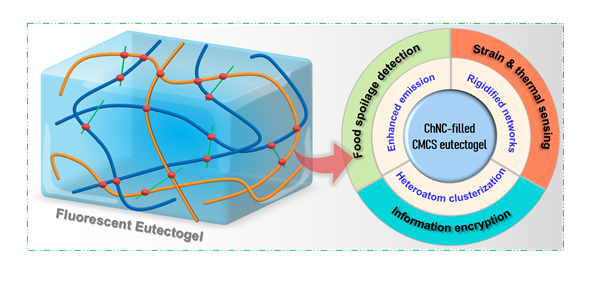
Using polysaccharide nanocrystals to regulate networks is a promising way to open up more functions and application scenarios for the eutectogels. A chitin nanocrystals (ChNCs)-containing eutectogel was fabricated herein via a ‘two-step’ method for the study. Using carboxymethyl chitosan/poly(vinyl alcohol) as the matrices, the hydrogel networks were constructed via the freeze-thawing treatment and boronic esterification, and then underwent solvent exchange with glycerol/choline chloride. The as-obtained eutectogel has a well-defined structure, in which ChNCs act as a ‘reinforcing bar’ and boronic ester (B-O-C) bonding as a ‘bridge’, collaboratively strengthen the eutectogel networks. The strength (1.75 MPa) and modulus (0.65 MPa) are improved remarkably, enhancing by 38% and 55% than those of the eutectogels free of ChNCs and B-O-C bonds. Moreover, the clustering-triggered emission (CTE) capability of eutectogels is evidently enhanced because ChNCs can rigidify the eutectogel networks with the aid of B-O-C bonding. Therefore, the developed fluorescent eutectogel exhibits a variety of potential applications: encrypting specific information by tuning the heterogeneity of eutectogel patterns, monitoring fruit freshness by capturing the volatile substances released during spoilage, and perceiving strain/thermal alterations as a soft substrate. This work paves a feasible approach of using polysaccharide nanocrystals to construct the eutectogel-based multi-tasking platform.
PDF DOWNLOAD:
https://www.sciencedirect.com/science/article/abs/pii/S0141813026045691
- [来源:中国聚合物网]
- 了解更多请进入: 吴德峰教授个人网站
- · Study on Radiative Cooling Performance of Cellulose Nanofiber/Gelatin Aerogels Tuned by Fiber Aspect Ratio
- · Solar-Driven Dye Wastewater Purification and Synergistic Desalination by an Aerogel-Based Multitasking Platform Structured with Polydopamine-Hybridized Covalent Organic Frameworks
- · Structuring Water Transport Pathway of Chitosan/Poly(vinyl alcohol) Hydrogels towards Achieving High-Efficiency and Salt-Resistive Solar Desalination
- · Constructing Reversible Phases through Solvent Engineering towards Activating Asynchronous Shape Morphing and Sensing Capability of Biodegradable Polyesters