- Exceeding 0.94% of solar-to-chemical energy conversion: asymmetrically charge-distributed local-double-charge layers for benzyl alcohol oxidation and hydrogen co-evolution
- 来源:李伟教授个人网站 2026-06-22
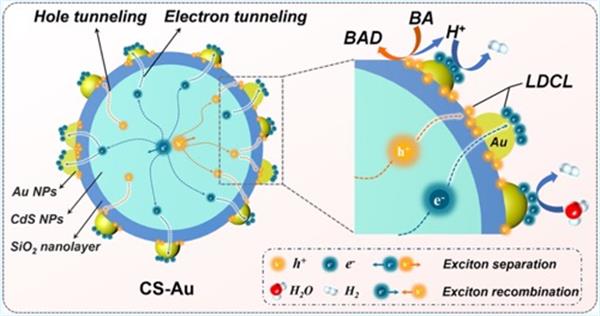
Solar powered hydrogen production is an appealing artificial photosynthesis technology. However, the slow and disordered exciton migration generally results in high-frequency photoexciton recombination and poor microstructural stability. Herein, a quantum-size thickness of SiO2 nanolayer was coated on CdS nanocatalyst to prepare a CdS@SiO2 nanoparticles with stable interfacial microstructure via a interfacial atomic-scale regulation strategy, and Au nanococatalyst was immobilized on this composite nanoparticles to construct the synergistic donor (CdS)-acceptor (Au) exciton transfer system. This unique asymmetrical structure significantly enhanced the local polarization, promoted the photoexciton separation and induced the exciton tunneling through SiO2 nanobarrier to form a local double-charge layers (LDCL), effectively hindering photoexciton recombination. Therefore, the benzyl alcohol (BA)-to-benzaldehyde (BAD) value-added oxidation (20.67 mmol·g-1·h-1) and collaborative hydrogen production (16.88 mmol·g-1·h-1) could be achieved at the LDCL region under simulated sunlight-irradiation. The isotope tracing technique was adopted to prove that H atoms in both BA and H2O participated in the H2 generation. More importantly, this optimized nanophotocatalyst is obviously superior to the most catalysts reported in literature, and the BAD selectivity is close to 100% due to the asymmetric exciton distribution. By processing polyvinylidene fluoride networked membrane, stable catalytic performance was maintained even being recycled for 30-times. This study proposes an observable exciton dynamics based on semiconductor-nonconductor-metal junctions.
- [来源:中国聚合物网]
- 了解更多请进入: 李伟教授个人网站
- · Dual-mechanism exciton dynamics of Au-decorated, C-doped CdS nanophotocatalyst for exceptional co-production of benzaldehyde and H2
- · Mo-doped ZnIn2S4 via partial Zn substitution for amplified electronic polarization and enhanced redox coupling photoactivity
- · Revealing spatially resolved exciton dynamics of dual active centers for dehydrogenation oxidation of benzyl alcohol coupled by hydrogen evolution
- · Latest advances on the design, preparation and application of CdS-based photocatalysts