- Structuring Water Transport Pathway of Chitosan/Poly(vinyl alcohol) Hydrogels towards Achieving High-Efficiency and Salt-Resistive Solar Desalination
- 来源:吴德峰教授个人网站 2026-01-29
Carbohydrate Polymers, 2026, 379, 125035.
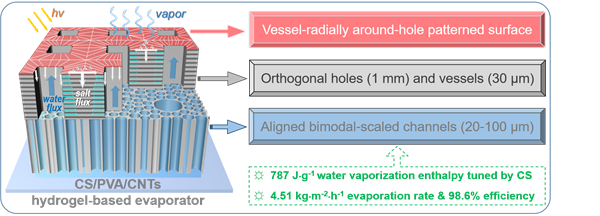
Hydration of polymer networks and hierarchical water transport pathways are crucial for hydrogels as solar evaporators, which require ingenious design from the molecular interactions and pore structures inside the hydrogels to the outside surface architectures. Herein, an anisotropic chitosan (CS)/polyvinyl alcohol (PVA) hydrogel was fabricated by combining the Hofmeister effect and directional freezing ways. Four types of water transport pathways were structured: vertically spaced holes (1 mm) and vessels (20-30 μm) in the top part, accompanied by smaller pores (5-10 μm) inside the hole walls, and the channels (20-100 μm) with bimodal size distributions in the bottom part. The vessel-radially around-hole surface pattern could be molded simultaneously, and the hydration ability was easily tunable by changing CS contents. The optimized hydrogel possessed good thermal insulation (0.30 W m-1 K-1) and excellent light absorption (>97%), and the vaporization enthalpy was only 787 J g-1. Thus, the as-fabricated evaporator showed a desirable performance with 4.51 kg m-2 h-1 evaporation rate and 98.6% energy efficiency (1-sun irradiation). A stable rate (3.02 kg m-2 h-1) could be well maintained over 100 h in the concentrated brine. This work also proposes an integrated strategy of structuring multidirectional pores and regulating water states of PVA hydrogel by using CS-phosphoric acid as precursor.
PDF DOWNLOAD:
https://www.sciencedirect.com/science/article/abs/pii/S0144861726001517
- [来源:中国聚合物网]
- 了解更多请进入: 吴德峰教授个人网站
- · Chitin Nanocrystal-Reinforced Fluorescent Carboxymethyl Chitosan Eutectogels
- · Study on Radiative Cooling Performance of Cellulose Nanofiber/Gelatin Aerogels Tuned by Fiber Aspect Ratio
- · Solar-Driven Dye Wastewater Purification and Synergistic Desalination by an Aerogel-Based Multitasking Platform Structured with Polydopamine-Hybridized Covalent Organic Frameworks
- · Constructing Reversible Phases through Solvent Engineering towards Activating Asynchronous Shape Morphing and Sensing Capability of Biodegradable Polyesters